Friday, January 31, 2020

Week 5 - Make the changes, be critical

What leads to positive change in teaching practice?
To reflect on teaching at a Masters level need to....
In comparison, a graduate of a Master’s Degree is able to:
“-show evidence of advanced knowledge about a specialist field of inquiry or professional practice
-demonstrate mastery of sophisticated theoretical subject matter
-evaluate critically the findings and discussions in the literature
-research, analyse and argue from evidence
-work independently and apply knowledge to new situations
-engage in rigorous intellectual analysis, criticism and problem-solving.” (NZQA, 2019)
Good to look at and aim for. 


Week 4 - The Leadership Dilemma of Adaptive Challenge - Bob Anderson


https://www.youtube.com/watch?list=PLD62C78D5F2C96599&v=Bp_K9mxJEqU&feature=emb_title

Feeling overwhelmed? This guy understands.

CEO's recognised global complexion
Creative to reinvent business when changes on regular basis.
Not going to change anytime soon.
In forecasting the future a world ambiguity market disruptions
Hit with waves of adaptive challenge = problems that can't yet must be solved.

We need a new system
The solutions from our current problems cannot be solved by current system.  WE NEED TO EVOLVE, coming at accelerating rate.
How to evolve leadership more complex than the problem we can lead through it.

=== the leadership circle....

Friday, November 29, 2019

Week 3 - Artefact of learning

The ukelele is my artefact representative of learning....

As it starts with the Pedagogical practices  (youtube clip on beginning learning) that lead to the Andraogical practices (https://www.thenukes.co.nz/) of co-constructing knowledge and then this leads to Heutagogical practices  (sheet music) of creating and becoming self directed.  It is also open to change and adaptable to all styles and cultures.

It also incorporates what we now about successful learning; that it is to be actively engaging, you want to learn the material, learning is personalised, not standardised, yet there is some structure (like learning the 3 basic chords).

It involves interaction as you need a listener or can play in a group.  Intellectual ability is not fixed, ie - you can learn one chord for or many leading to create your own music.
Ukelele and learning can  take place in a variety of settings, like in the classroom or on an island!

Week 2- Self directed learning

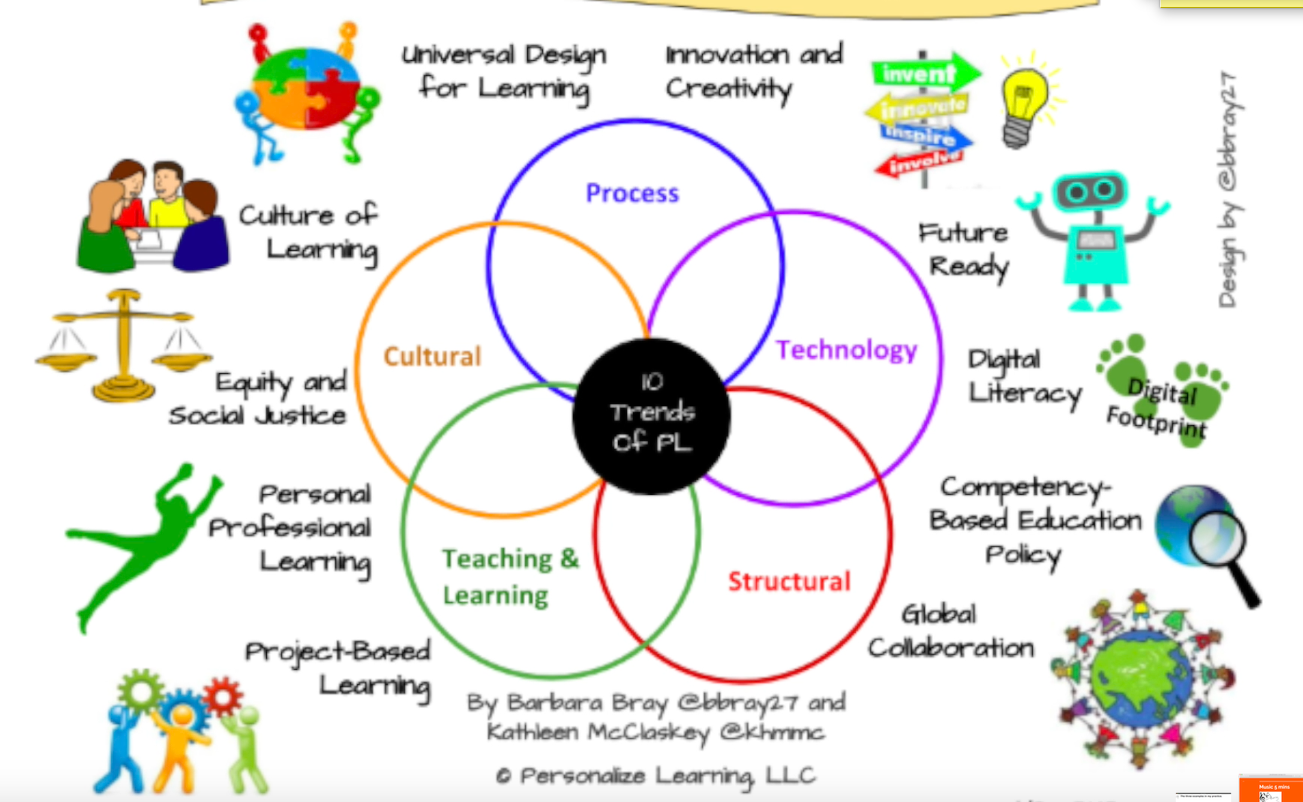
A few readings this week, yet being a visual learner I enjoy the one my Barbara Bray and Kathleen McClaskey suggesting how to self directed learning integrates a wide range of skills and attributes that link with one another.  The ten trends they say....


I used a staff meeting 5 minute meeting to integrate some of these self directed learning by adding links to other aspects that teachers could research further into themselves.  I stuck the timer on then invited each to play a ukelele so active in their learning, working to their own level.  They had dots on them for quick scaffolding to learn the chords. They also had the option of choosing other instruments to play.  They afterwards could downloaded a pdf which I emailed it to the staff for later online you tubes, tutorials and references to refer to.  This meant that not all information was summited in the moment and led to a lot of positive feedback from staff as presenting information was quick, sharp and informative.


This means even teachers appreciate personalised learning...


References :

Bolstad, R., Gilbert, J., McDowall, S., Bull, A., Boyd, S., & Hipkins, R. (2012). Supporting future-oriented learning & teaching: A New Zealand perspective. Wellington: Ministry of Education. Retrieved from:
Bevan-Brown, Jill; McGee, Alyson; Ward, Angela and MacIntyre, Lesieli. Personalising learning: A passing fad or a cornerstone of education? [online]. New Zealand Journal of Educational Studies, Vol. 46, No. 2, 2011: [75]-88. Availability: ISSN: 0028-8276. [cited 01 Aug 18].
New Zealand Ministry of Education. (n.d.) Personalised assessment practices in a secondary context. Retrieved from: http://assessment.tki.org.nz/Assessment-for-learning/School-stories/Personalising-assessment/Personalised-assessment-in-a-secondary-context
Leadbeater, C. (2005).‘The Shape of Things to Come personalised learning through collaboration’. Retrieved from:
Strauss, V. (2013). ‘Personalization’ of learning: Genuine or slick marketing? Retrieved from:
Prince K. (2014). A vision for radically personalized learning. Retrieved from:https://youtu.be/y9ZX9ApLLh0

Week 1 - The Three Gogies

https://drive.google.com/file/d/1ZBpDTbReSkvZhjuZT9tTQ56xjAOV2hip/view?usp=sharing

The Three Gogies

I looked to my own practice to integrate the gogies
1. Pedagogy
2. Andragogy
3. Heutagogy

This is so I could see the similarities and differences in the gogies in my everyday practice.

References...

1. Jackie Gertein blog, see:
This blog has interesting definitions of pedagogy, andragogy and heutagogy. Can you see any differences in the ways each one is articulated and defined? For example, pedagogy seems to have a clear role of the educator and learner - is this the same for andragogy and heutagogy?
2. The ‘School in the Cloud’ - this video is an inspiring TED talk about self-organised learning environments:
3. The first two chapters of this book are useful to get into Heutagogy:
Blaschke, L., Kenyon, C. & Stewart Hase (2014) (Eds.). Experiences in Self-determined Learning.
Chapter 1 -An Introduction to Self-determined Learning (Heutagogy) Page 15
Chapter 2- Heutagogy and Systems Thinking: A Perfect Marriage for Conducting Learning Experiences. Page 314. Example of the term Pedagogy from Australia
4. Example of the term pedagogy from Child Australia is useful
5. Paper that discusses some differences between pedagogy and andragogy
6. A book that has a good first chapter on Andragogy - a quite detailed history of it.
Merriam, S. (2001). New Directions for Continuing: The new update on adult education. No. 89, Spring Jossey-Bass: San Francisco, California
Chapter 1 - Andragogy and Self-Directed Learning: Pillars of Adult Learning Theory by Sharron Merriam https://pdfs.semanticscholar.org/348f/4ec482384d90bafad92e226fa4471ff56539.pdf
Other References
Blaschke, L. M. (2012). Heutagogy and lifelong learning: A review of heutagogical practice and self-determined learning. The International Review of Research in Open and Distributed Learning, 13(1), 56-71.
Blaschke, L. & Hase, S. (2016). Heutagogy: A Holistic Framework for Creating Twenty-First-Century Self-determined Learners. Springer-Verlag Berlin Heidelberg 2016
B. Gros et al. (eds.), The Future of Ubiquitous Learning, Lecture Notes in Educational Technology, DOI 10.1007/978-3-662-47724-3_2 https://www.springer.com/cda/content/document/cda_downloaddocument/9783662477236-c2.pdf?SGWID=0-0-45-1519498-p177541637.
Hase, S., & Kenyon, C. (Eds.). (2013). Self-determined learning : heutagogy in action. Retrieved from https://www.researchgate.net/publication/305778049_Self-determined_Learning_heutagogy_Where_Have_We_Come_Since_2000

Monday, July 22, 2019

Reflective entry #8: Reflect on how you have changed your practice during your Postgraduate DCL journey

The Postgraduate DCL journey. 
On reflecting so far, I can see I have up-skilled in the knowledge of coding and STEAM as a practice and the importance of developing a hands on approach to learning through developing play based methods. 
Assessment has been evidential through videos and children self and peer reflecting rather than traditional formative test formats. Osterman and Kottkamp (1993)
In this model, the Cycle of Experiential Learning, is recommended by Osterman and Kottkamp (2015, p.70) in their “Reflective Practice for Educators”

(Osterman and Kottkamp, 2015, p.70)
Stage 1: Problem identification
The problem articulated was that children's literacy needed to be improved as a whole school, as well as, a classroom setting, with new and modern methods of engagement such as coding. 
  1.  The problem that arises in practice is facing that learners are entering into a new global market and that many of their jobs may be replaced by robots in the future.  Myself as a teacher therefore needs to teach in relevant ways to meet these demands. 
  2.  It is important to implement the change to be better service leadership for the learners under my care. 
Stage 2: Observation and analysis
  I have gathered data that shows evidence that through coding; children's literacy can increase in a greater fluency. Therefore; the insights I have gained is that students, when engaged and self driven in their learning, can aquire greater results of achievement. (a bit like teachers really) 
Stage 3: Abstract reconceptualization
New theories in coding and research that suggests the benefits of coding across all curriculum areas helped to implement change in my inquiry.   The global trends on robotics for the future, were also perspectives that needed to be considered. 
I have found that by adapting the circle of inquiry myself and seeing the benefits to the learning process.  My teaching practice has changed as it has become more a process of inquiry.  It has adapted the 21st Century skills and more aware of global trends that are occurring in education. 
 pp.87-88 of “Reflective Practice for Educators” (Osterman & Kottkamp, 2015)
In “Our Code, Our Standards”.  The key change in my professional practice links to the commitment to the teaching profession where we look at 
1. demonstrating a commitment to providing high-quality and effective teaching
  • In my inquiry I have provided high quality and effective teaching through using coding with 6 year olds to engage in the STEAM process.  It has helped to achieve whole school aims also as well as in the community of learning to raise literacy.  • This linked with the spiral of inquiry; "It is specifically designed to change outcomes for learners in important areas" Kaser, L. & J. Halbert. (2017)
  • I would like to, in the future, build on this further with continuous PD on STEAM practices and incorporate them into my teaching. I have taken a staff meeting to teach other staff the makey-makey and supporting my peer teachers on how to use in their classrooms also. This achieves the code of conduct on peer leadership.  I would like to continue also linking these practices to the A in STEAM as being the music unit holder of the school, to have a strong leadership in this area.
Stage 4: Active experimentation
After applying a metacognitive lens towards my initial goals which were to up-skill in the latest technology and to be knowledgable in the latest teaching styles, to be a contemporary learner and to inspire to inquire.  I can see that  goals have and are continually being achieved. It has been a learning journey and I have recognised significant changes to my teaching approach. 

Overall; I have implemented the new practice of play based learning and STEAM practices for juniors.   Through this, I have learned that hands on learning means children become more engaged and the benefits to success across curriculum areas is greatly improved also. 
References
Bolstad, R. & MacDonald,J.(2016). An analysis of participant blogs supplemented by teacher interviews. Wellington:New Zealand Council for Educational Research.
Kaser, L. & J. Halbert. (2017). The Spiral Playbook: Leading with an inquiring mindset in school systems and schools. C21 Canada. Retrieved from http://c21canada.org/wp-content/uploads/2016/10/Spiral-Playbook.pdf
Osterman, K. & Kottkamp, R.(1993). Reflective Practice for Educators.California.Corwin Press, Inc. Retrieved from hhttp://www.itslifejimbutnotasweknowit.org.uk/files/RefPract/Osterman_Kottkamp_extract.pdf
Osterman, K. F., & Kottkamp, R. B. (2015). Reflective practice for educators : professional development to improve student learning.(2nd ed.) New York: Skyhorse Publishing. “Reflective Practice for Educators”
Ministry of Education (2017). Our code, our standards. Retrieved from

Reflective entry #7: Evaluate how your inquiry impacts on future inquiry/practice

Evaluate how your Inquiry impacts on future Inquiry/practice

My reflection, based on a reflective model such as 
Rolfe's model which we have broken into these three steps below: evaluates how my inquiry on coding to increase literacy impacts on the community of our school and their families that I engaged with, their current needs of enhancing 21st Century skills, and your future practice to further develop this research based teaching practice in daily teaching practice. 


Step 1: What is the actual impact after the ‘Take Action’ phase?

The observed impact of the 'take action' phase, is that children have become better engaged in their learning and are partaking in a pattern of spiral of inquiry themselves.  I have noticed also as the evidence suggests that the children's results in the other curriculum areas, such as science and mathematics have increased also as well as, literacy.  As the research in other countries alerted me to initially.  
The coding at school also has filtrated into other areas of learning and sparked interest in children gaining an awareness of their own potential and the feeling when new doors are opened up.  This is something that cannot be measured, yet just as valid I believe in changing attitudes to become more positive towards education as a whole and teacher practice.  I suppose a spiral of positivity. 

Step 2: How is the actual impact different from or similar to the anticipated one?

My inquiry impacts on the community as children have the attitude to take better ownership of their learning and have a greater enjoyment of school as a result and this type of learning goes home also.  Like on the tki maths example "They wanted their teachers and students to co-design maths learning together".  Four different sets of parents  have commented at parent teacher interviews that they ‘fake’ being well to come to school. I think his is a good indicator of enjoyment.

Step 3: What is the impact on future inquiry/practice?

What I would do differently is have better confidence in myself and the research to take bigger risks earlier on.  I ask he questions as in research
Do teachers always set tasks? 
Do learners feel they have choice about who they learn with? for greater owner ship of learning. 

To have the growth mindset myself to think I can do it, I may fail, yet do it anyway. Instead of treading lightly in the name of research.  Get a gradual change is more concrete in the long term results.  To foster the culture of inquiry in students.  I would also set up better STEAM I already have a 6 year old wanting to create an ancient civilisation made from junk in the holidays (next terms concept). She wants to add makey-makey sounds of the people when she comes back to school.  We will see where this goes! 
As it says in Stoll (2015)  Spirals of Enquiry is a different way of approaching enquiry which confronts, challenges, shifts paradigms and energises!

References
Halbert, J., Kaser, L., & Koehn, D. (2011). Spirals of Inquiry: Building Professional Inquiry to Foster Student Learning. Paper presented at 24th International Congress for School Effectiveness and Improvement. Limassol, Cyprus. Retrieved from http://www.icsei.net/icsei2011/Full%20Papers/0053.pdf
Ministry of Education (n.d.). Primary school teachers use maths assessment to increase student agency. Retrieved from http://elearning.tki.org.nz/Teaching/Snapshots-of-Learning/Spirals-of-inquiry-Maths-assessment
Stoll, L., and Temperley, J. (2015). Narrowing the Gap with Spirals of Enquiry: Evaluation of Whole Education’s Pilot. Whole Education, UK. Retrieved from http://thesendhub.co.uk/wp-content/uploads/2016/09/narrowing-the-gap-with-spirals-of-enquiry.pdf