Monday, July 8, 2019

Reflective entry #5: Discuss how ethical issues are being addressed while you are taking action (20%)

Reflective entry 5: Discuss how issues of ethics are being addressed while you are taking action 

The ethical issue that I want to focus on in this entry is the mis use of internet use.  That the 6 year olds were looking up zombie clips when meant to be looking up 'scratch'.  

Due to the New Zealand context of our classrooms.  I have found the simple questions as asked in the Waikato reading; Hall (2001) to make the following ethical questions on my inquiry and to reflect that there is a dilemma for inquiry if we do not use implications.  

Which community members should be given priority?  
It is the children in my care and their families.  Why ? because it is my commitment for learners and their whanau as a professional responsibility stated in the code of conduct for teachers. 
2.4 In the conception, design, conduct, reporting and dissemination of the research there should be thoughtful concern for the rights and interests of all the individuals, groups and institutions involved and affected by it. 

What restrictions are there to your actions? I set up of class with any computer internet access facing the teacher desk. I have linked the Ipad use to the daily 5 programme and the target groups which I work 1 on 1 with.  I therefore had to consider that we are using the internet for the set purpose. .

Which courses of action are possible?
The consequence of this is that I had to take action. I should ask myself. Like having the computers facing me when working with a small group and checking in with internet gurus to monitor that all is well on the googling of scratch.  I have limited apps on the IPads and there are whole school bans on sites however, safari opens up a new world that a 6 year old child can access in a blink of an eye, zombies, that maybe appropriate at home for some, cause a new level of offense to others.  It is also a question of staying on task and adapting good work /study habits.

How should the course of action be implemented? 
I looked at the whole structure, as well as the class and then the individuals involved, as well as the wider whanau. At parent interviews, I have had to listen to the parental concerns and with others explain the internet guidelines as a school. In class; set up new guidelines of freedom in the inquiry process.   To monitor carefully the internet history.  I chose to initially talk to the whole class about appropriate internet use and linked to the analogy of diet, that we choose to feed our bodies healthy food for healthy bodies, likewise with our minds.  The monkey see no evil, hear no evil, fits in with our special character, yet also is a learning curve for all children as the internet and how to use it responsibility is a skill,  they all can use.  It is also good to talk one to one with those concerned on the specifics. 
I re-looked at the internet policy of the school reading it out in child speak so that the small group of children involved are aware that these are rules in a wider sense created by the school as a whole for all. 


It caused me to reflect when digital learning happens in the classroom there is an internet etiquette on when is the time and what kind of questions to ask myself from this reading by Hall (2001)
 
References
Connecticut’s Teacher Education and Mentoring Program. (2015). Ethical and Professional Dilemmas for Educators: Facilitator’s Guide: Understanding the Code of Professional Responsibility for Educators. Connecticut, US: Author. Retrieved from http://portal.ct.gov/-/media/SDE/TEAM/Module_5_Supplemental_Scenarios-Facilitator_Guide_January_2015.pdf?la=en
Ehrich, L. C. , Kimber M., Millwater, J. & Cranston, N. (2011). Ethical dilemmas: a model to understand teacher practice, Teachers and Teaching: theory and practice, 17:2, 173-185, DOI: 10.1080/13540602.2011.539794
Hall, A. (2001). What ought I to do, all things considered? An approach to the exploration of ethical problems by teachers. In IIPE Conference, Brisbane.
New Zealand Association for Research in Education (NZARE). (2010). NZARE Ethical Guidelines. Retrieved from http://www.nzare.org.nz/portals/306/images/Files/NZARE%20EthicalGuidelines2010.pdf

Saturday, June 22, 2019

Reflection entry #4 Apply a Reflection Model to discuss something that has happened in my Inquiry so far, and how it impacts on taking action.

Reflective entry 4:

In Finlay's article it states; ‘while we commonly assume that teaching leads to learning, it is the experiences which teaching helps create that prompt learning, not primarily the acts of the teacher’.”
 (Redmond, 2006, p.226)  
This is true in my class with reflecting, you can have the “courage to work competently and ethically at the edge of order and chaos” (Ghaye, 2000, p.7).  I am therefore using Rolfe’s Model of Reflection (Otago Polytechnic, n.d. ) to reflect on my practice so far. 

Step 1 (What): Describe something that is significant and has happened during your Inquiry so far
A notable event that has happened so far is recognising that I needed more ideas to engage the children in my inquiry.  Getting ideas and momentum was the most difficult.  I realised that to counteract this was attending the lecture on robotics and STEAM at the University of Auckland, Epsom Campus.  Chris Rogers is from TUFT's university, Chicago, America and he talked about his philosophy of education as it relates to coding and robotics.
https://www.youtube.com/watch?v=DblvNncjR9o
Step 2 (So What): Evaluate the most interesting/important/useful aspects of this event

Attending this event has allowed me to develop my practice as it created a boost in the purpose of coding and the reasons why we do it.  He asked us what do we want children to learn, curiosity and challenging exisiting thinking were some outcomes.  It made me reflect do I provide in my current classroom climate situations for this to occur?  The support therefore was not just from readings but from real life bumping shoulders with other educators and creating robots ourselves  serve a need. In working with a other educators we created a robot that could move without wheels, a fridge door that talked to close and shared with other educators their designs.

Chris shared various ideas relating to Music which is my unit, making instruments and having the brief of performing a concert creates more open ended 'tasty' designs and 'experts' in certain areas rather than a status quo 'cheeseburger' scenario. 
The affect it had on my future practice or understanding: is that it inspired me to adapt some of these ideas back into the classroom. I developed lego scenarios for students on animals and made them come to 'life' with makey-makey sounds.  This proved successful and the levels of engagement fro the students were outstanding.   The experts advice worked giving a simplistic brief for children such as to create instruments for a concert, or make a cute animal and allowing children to 'breathe' and create their design meant a variation in the outcomes.   
Step 3 (Now What): Analyse the implications from this event to the rest of your Inquiry
In the future I can now adapt these practices of STEAM more and more and create innovative ways to bring them into the classroom.  With the new 14th June NZEI negotiations taking place mentioning to relook at the way teachers are 'assessed' through appraisals, can provide a future vision for more risk-taking and learning with students to create innovative projects integrating this with other learning areas.   I also have found that not only my target group wants to adapt these practices yet every child in the class wants to give it a go, so I have had to adapt my classroom practice for the last two weeks of term to allow the space to create 'energy projects' for all students, based on the ideas from Chris and also from what I have read on play based learning.  I have in my classroom now, boats, submarines, microphones, cars and rocket ships. Six year old  students are researching on Ipads how rockets are designed, whanau engagement is up as they mention in the morning their lunch time bands, engagement is up! 

You can see the results in my seesaw blog page; 

6 year olds coding = Increasing literacy engagement. 

https://blog.seesaw.me/room1942019/#!/item/item.c3b3fdf4-42e7-4c41-8e4e-96549a4208aa


Friday, June 21, 2019

Reflective Entry #3. Cultural responsiveness.

I have a vege garden.... my coriander grows better as it is on the side.  It has the sun, the warmth, it isn’t pecked by the chickens.  It is fenced off in great growing conditions. My broccoli, however is hen pecked.  It is withered it is worn. 

As being culturally responsive is what we pay attention to and what to stay away from.  The analogy of planting seeds, is that with diversity  we weed, water, watch and let grow.  Just like my fence from the chickens, community is ‘companion planting’ based on a rich connectivity in public and private space and to orchestrate activities in both.  That in this there is strength in relationships in both. Edtalks also mentions; Communities have multigenerational structures and a vibrant community is not invented or forced, but grown. 
For culturally responsive pedagogy I position myself as a learner to support diverse ways to develop, express and strive. 

Community need(s)
Living in Tai Tokerau, it has been identified as a larger Maori population NZ wide.  An aspect as picked up by the Education CoL and the achievement aim of raising Maori achievement in literacy, particularly in Maori Boys.  This is the wider aim of my inquiry also. Our school vision has 'enhancing mana' as seen by the community as being the most important for our students.  This links to - mauri ora life force of student engagement success in kapa haka just as important, to feel safe valued and ako - learning styles kinesteheitc  Maori boys part of uplifting his identity and hapu iwi contribute through formal and informal means of chat.   Tai tokerau as a whole needs to uplift Maori learners and create situations for tino rangatiratanga.  However, under Dr Anne's critical thinking, I need to ask, is this perception coming from a place of expectation from me to be more pakeha or embrace Maori as Maori?  Reading the Culturally Responsive Curriculum Scorecard prompts me to make changes, awareness is key. 

Personally; what resonates with me is the Mauri model from Pohatu, as it links with well-being of the teacher in relation to energy, to be in a state.  It reflects on 3 states
1.  
Mauri moe = to be asleep, you have potential yet you still haven't moved forward and improved your own practice.  
Mauri oho - waking up from a sleep - starting to participate in discussions and meeting with whanau, learn wiaata, 
mauri ora - to be really alive and thriving in an active state, whanau engagement and commitment as a whole group.   In reflecting on my own practice  I can the kapa haka and incorporating matariki in our energy coding concept.  I am aware of pedagogies that engage Maori students, yet this can grow. 

I have participated and contributed to others study on these concepts. I use te reo as much as possible as doing the inquiry, as I am interacting with the students.  I would like to engage in speaking more te reo to whanau in correspondence on their results

I believe, I am in between Mauri moe and Mauri oho.  I am learning also to recognise these states more as it relates to my culturally responsive pedagogy as I teach. 


Therefore, the community can be continuous and organic and an ongoing journey.  I am in the purple zone yet no 'colonisational' hen pecking, as Dr Anne suggests, yet an awareness as educators we are all planting the seeds, creating environments for a community of responsiveness.

tihei mauri ora

References

Cowie, B., Otrel-Cass, K., Glynn, T., & Kara, H., et al.(2011). Culturally responsive pedagogy and assessment in primary science classrooms: Whakamana tamariki. Wellington: Teaching Learning Research Initiative. Retrieved from http://www.tlri.org.nz/sites/default/files/projects/9268_cowie-summaryreport.pdf
CORE Education.(2017, 17 October). Dr Ann Milne, Colouring in the white spaces: Reclaiming cultural identity in whitestream schools.[video file]. Retrieved from https://www.youtube.com/watch?v=5cTvi5qxqp4&feature=em-subs_digest

Edtalks.(2012, September 23). A culturally responsive pedagogy of relations. [video file]. Retrieved from https://vimeo.com/49992994

Milne, A.(2017).Coloring in the white spaces: reclaiming cultural identity in whitestream schools. New York: Peter Lang Publishing, Inc.

NYU Metro Center. (2019). Culturally Responsive Curriculum Scorecard. Retrieved from https://steinhardt.nyu.edu/scmsAdmin/media/users/atn293/ejroc/CRE-Rubric-2018-190211.pdf.


Pohatu, T. W. (2011). Mauri - Rethinking human wellbeing. MAI Review, 3, 1-12. Retrieved from http://www.review.mai.ac.nz/index.php/MR/article/v...


Thursday, June 13, 2019

Reflective entry #2: Discuss how aspects of law, regulations and/or policy impact on teacher inquiry.

Reflective entry #2: Discuss how aspects of law, regulations and/or policy impact on teacher inquiry

There are many aspects of law, regulations and policy that relate to teacher inquiry.  In page .18 of the regulation ‘Our Code, our Standards’:  It states that in these professional learning standards, teachers can "use inquiry, collaborative problem solving and professional learning to improve their professional capability to impact on the learning and the achievement of all learners".

In our school the codes and standards are embedded into the appraisal process as a teacher inquiry google slide, which we write reflective notes and add evidence beside each code of conduct.  Teachers have an opportunity to create an over all encompassing inquiry.   In my case, it is in coding and how it raises the standards in other areas.  I also through my research, "engage in professional learning and adaptively apply this learning in practice."  In coding and makey-makey, the inquiry process is reflected in my school practice, as it is tied up in my appraisal in a yearly bases. We gather feedback from senior leaders and record this evidence and then use the evidence to see if we meet this code.  

On the online platforms it covers the Professional Learning of "seek and respond to feedback from learners, colleagues and other education professionals, and engage in collaborative problem solving and learning -focused collegial discussions".  This research has been interpreted into the school policy and imbedded into teaching practice to improve learner outcomes. 
When I inquire into and reflect on the effectiveness of practice in an ongoing way, I can identify inquiry from a range of sources;

This ERO’s report lists the characteristics that were evident in effective appraisal systems and “inquiry” is one of them.  As a result, it refines and strengthens teaching as inquiry and therefore measuring this by moving from a focus on compliance to a focus on continual improvement. 

Additionally, P.92-101 in the reading ‘Teaching as Inquiry: form, purpose and application in New Zealand Secondary Schools’ by Wood (2015)  It suggests that leaders need to make the Teaching as inquiry process more robust, valued and an essential component of the school faculty and individual teacher self review. It can kill two birds in one stone as it can relate to Professional Development aims also.  
Wood talks about the length of the teaching inquiry to be over a year is better rather than a short 6 -4 weeks.  He also suggests that it is an inquiry and not to be related to assessment and data gathering on teachers. These elements are evident in my schools inquiry process. 

Broadly speaking and in looking at the wider context, the Communities of Learning in Northland, affects Teacher inquiry. In the CoLs, it states the role is to be reflective competent personal and collaborative inquiry - "be wiling to learn and then unlearn and then to relearn". 
Sinnema (2005) suggests that evidence about student outcomes can be a focal point 
The policy of the Community of learning also affects teachers enquiry, as it has the achievement aims on well being stated. One of the purposes was to "strengthen the use of effective inquiry approaches to teaching across schools to achieve the shared learning outcomes"  It says as part of the role to lead structured opportunities to assist the ongoing development of effective approaches to 'teaching as inquiry' so it does include the code of conduct aims. 

 I have found that the inquiry that I am undertaking in coding has raised my passion for teaching and ignited a new journey of administering practices that work well for students, as well as nourishing myself to be a life long learner myself also.


References

Education Council (n.d.). Appraisal as a catalyst for improved learner outcomes. Retrieved from https://teachingcouncil.nz/sites/default/files/ERO_Appraisal.pdf
Wood, C.(2015).Teaching as Inquiry: form, purpose and application in New Zealand secondary schools. (Published Master's’ thesis). Unitec, Auckland, New Zealand.


Tuesday, May 28, 2019

Reflective Entry #1 - The context of different audiences.


Reflective Entry 1:
In my Inquiry, I am addressing the context of different audiences (local, national and/or international)  My local audience is the students themselves in the Accelerated for Learning (ALL) group, their immediate whanau and extended whanau. The senior leader and therefore the principal.  Nationally, other teachers in the communities of learning that are involved to raise standards of literacy for haoura- well being and success.   The wider audience is also society as it links to the National well being budget that was released by the government recently. 

In their document; “Supporting future-oriented learning and teaching: A New Zealand perspective” (Bolstad, Gilbert, McDowall, Bull, Boyd & Hipkins, 2012),  identified the role of current and emerging technologies as an emerging principle for a 21st century education system.  In this, they mention  four components of effective teaching of technologies in the classroom being;
providing enabling tools and infrastructure
providing inspiring ideas and opportunities to connect ideas.
enhancing capacity
supporting innovation
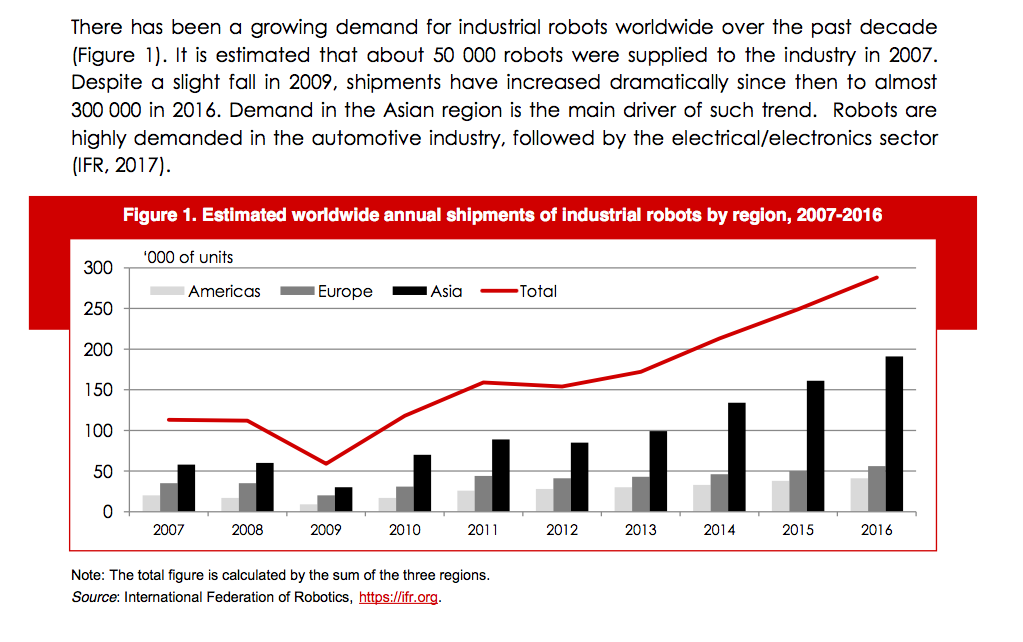
All four components need to be present in order to support meaningful changes in practice.   The global audience is related to the trends expressed in the graph; 

Trends shaping education spotlight (OECD, 2018), Robotics and coding has increased significantly and robots are talking over many labour enforced jobs, as you can see by the graph.


Emphasis on STEM-focused educational programmes has risen internationally in response to these trends (Ritz and Fan, 2015). Programmes addressed STEM education across all levels of education; while some focused on improving learning in stand-alone subjects, 
Therefore the play based approach, to teach the core curriculum subjects through the means of coding, will help to develop children into 21st Century thinking to embrace the future demands. 

The attitudes and perspectives in my audience may be such is that; if they witness my class room is that they are playing are they actually learning? What a mess! There may be scepticism about this play based approach and question it's validity for 'real learning' possibilities. 

 Through my inquiry the students will become more equipped to face these International trends as also referred to in the reading from  International Robotics Federation. 

My inquiry does have the impact and the four steps as clearly stated out above with play based learning and using real life contexts linking to literacy, the children will gain knowledge in coding.  

providing enabling tools and infrastructure - with I-pads, laptop use, scratch apps.

providing inspiring ideas and opportunities to connect ideas.- the children use real life problems that they come across related to ‘Energy Matters’ for example creating instruments linking to makey-makey. 

enhancing capacity - with exploration of the apps in the class to up-skill.  Integrating into the timetable. 

supporting innovation - linking with the circle of inquiry and allowing clear organisation and a risk taking, growth mindset.

They also will learn to be risk takers and will make improvements in other areas such as computational thinking and brushing heavily on the essential skills as reinforced in the curriculum. 

 By reading the first part (p.4-8) of ‘“Addressing Current and Future Challenges in Education” it analyses what  schools should do to prepare students to be successful in the rapidly evolving global economy.  It is suggested that children come to school as ‘digital natives’ yet they come to school and power down their devices.  My coding practices via play based learning helps to reinforce and normalise digital technology that is happening in their lives on a daily basis anyway. 

Teachers can use pedagogies such as Expeditionary learning (EL), a model of education powered by the growth mindset. Schools pledge to help students become "leaders of their own learning" 


References


Education Council. (2017). Our code, our standards. Retrieved from https://educationcouncil.org.nz/sites/default/files/Our%20Code%20Our%20Standards%20web%20booklet%20FINAL.pdf

Bolstad, R., Gilbert, J., McDowall, S., Bull, A., Boyd, S., & Hipkins, R. (2012). Supporting future-oriented learning and teaching — a New Zealand perspective. Report prepared for the Ministry of Education. Retrieved from https://www.educationcounts.govt.nz/publications/schooling/109306

Daggett, B. (2014). Addressing current and future challenges in education. Retrieved from http://www.leadered.com/pdf/2014MSC_AddressingCurrentandFutureChallenges.pdf

OECD. (2018).Trends shaping education 2018 spotlight. Retrieved from http://www.oecd.org/education/ceri/Spotlight-15-A-Brave-New-World-Technology-and-Education.pdf


Thursday, April 11, 2019

Week 20 - Kaupapa Māori Approach linking to robotics/coding.

Kaupapa Māori Approach as You Develop the Inquiry Question
As with the previous weeks, we hope you reflect on the Kaupapa Māori approach as you develop the Inquiry question.
  • Whānau - the family structure principle The whānau and the practice of whanaungatanga (family connectedness) is an integral part of Māori identity and culture. What other perspectives may be relevant as you apply your new learning from the literature to your Action Plan
  • Family connectiveness is evident in especially research done with robotics with girls.  They seem to respond more consistently to human personalities in robots and design as such.  I I have noticed in the classroom I teach, girls, particularly Maori girls will create robots that have faces and they talk and connect to one another through them. 
  • Kaupapa - the collective philosophy principle Kaupapa Māori initiatives are held together by a collective vision and commitment. In what ways does your new learning from the literature that you will bring to your action plan connect to a collective vision and commitment?
  • The collective vision of my inquiry question relates to the whole school vision of embracing mana and enhancing futures. We have added this element of mana to our school vision so that we can aim to focus on the well being of the holistic child.  We are committed also to enhancing futures and robotics/coding is a platform to do so. 

Thursday, April 4, 2019

Week 19 - Reflections - Applying Kaupapa Māori Approaches to ‘Developing a Hunch’

Applying Kaupapa Māori Approaches to ‘Developing a Hunch’
This week’s principles of Kaupapa Māori that you should reflect upon in your Action Plan document are:
  • Tino Rangatiratanga - the self-determination principle: To what extent is your hunch different from (or similar to) the literature in how the area of focus helps the students/whānau to get meaningful control over the student’s learning and cultural well-being?
  • My hunch to increase robotics in my classroom inquiry practice to increase literacy works well with the Tino Rangatiratanga principal.  Target students are praised informally in morning , as well on face book with use of scratch in the class.  A parent mentioned she used it at home and her son "loved it".  This is included in formative assessment strategies.  Whanau help in mornings and engagement is also acknowledged as they get the makey-makey bug also. 

  • Ako - a teaching and learning relationship: How is your hunch different from (or similar to) the literature regarding the perspectives of people other than the teachers on the area of focus?
  • My hunch is different in that it is with younger students.  I am aware that they are clearly digitally advanced and have high expectations.  Some of the literature is aimed at older, yet my students can also engage in these activities.  I do not set an age limit (although the requirements from the digital curriculum for their age level are also clearly reached. 
  • My hunch also links music and haoura to the robotics, as well as the circle of inquiry. Linking all these elements together is not too much, yet hones in further for a greater focus.